
Artificial turf is growing in popularity across Florida, especially as homeowners look for ways to reduce water usage, cut lawn maintenance costs, and keep yards green year round.
Now, Florida’s House Bill 683 is changing how artificial turf is regulated throughout the state, and many homeowners are wondering what that means for their property, HOA, and landscaping plans.
In this article, we’re going to cover what Florida HB 683 is, how it affects synthetic turf installation on your property, and what you need to know to stay compliant.
Key Points About Synthetic Grass & Florida HB 683
- Florida House Bill 683 was signed into law in 2025 and is a statewide construction regulation bill that includes major changes for artificial turf installation on residential properties.
- The bill limits the ability of local governments to ban or heavily restrict synthetic turf installation as long as it meets requirements designated by the Florida Department of Environmental Protection (DEP).
- New standards for artificial turf have been proposed by the DEP, ensuring that any turf being installed must not include heavy metals or toxic chemicals, and also must include proper infill, backing, and drainage.
- Modern Grounds’ professional artificial turf installation already meets all of the proposed requirements with US-made, eco-friendly synthetic grass, and follows the latest installation standards per the Synthetic Turf Council.
What is Florida HB 683?
What Does the Law Actually Say About Synthetic Turf?
According to Florida HB 683, the Florida DEP must establish minimum standards for synthetic turf installations, and cities and counties cannot prohibit homeowners from installing compliant artificial grass on single-family, residential properties.
It also establishes that local governments cannot establish rules that conflict with the state’s standards.
The legislation also requires the DEP to consider the following factors when creating the synthetic turf standards:
- Material type and color
- Water conservation
- Drainage and permeability
- Stormwater management
- Water quality impacts
- Proximity to trees and landscaping
Learn: Why High-Quality Artificial Turf Installation is Worth the Investment
What are the Proposed Rules for Artificial Turf in Florida?
The Florida Department of Environmental Protection (DEP) has proposed the rules for synthetic grass as required by HB 683, and next we’ll cover all of the specific criteria.
1. Who is Affected by HB 683?
Applies to single-family, residential properties of 1 acre or less in size.
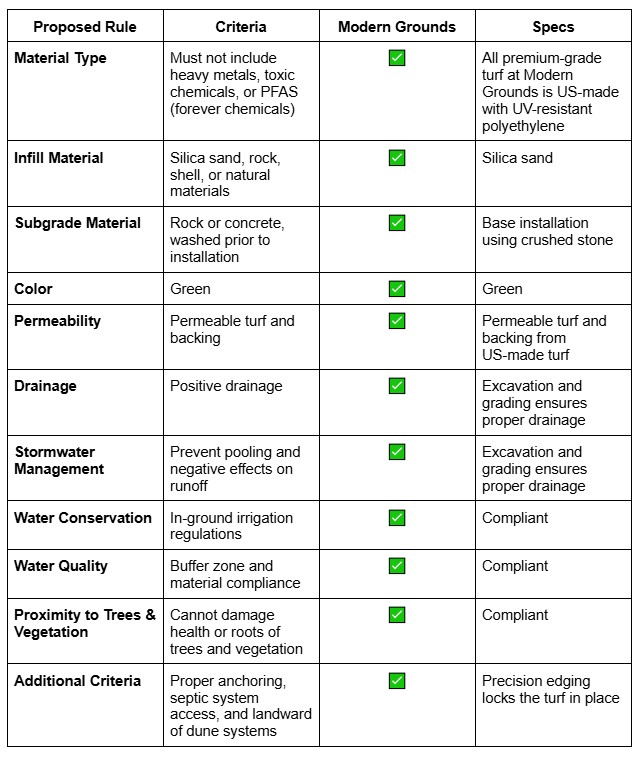
2. Criteria for Artificial Turf Material Type
Synthetic turf, including backing and infill, must not contain heavy metals or intentionally added per- and polyfluoroalkyl substances (forever chemicals), and must be disposable under normal conditions at Florida permitted landfills.
3. Criteria for Synthetic Grass Infill
If used, silica sand, rock, shell, or other natural material may be used, but rubber or synthetic infill materials are only allowed within the footprint of playground equipment.
4. Subgrade Turf Grass Material
Subgrade needs to be washed prior to installation, and must be made of natural materials, such as crushed rock or concrete, that meet permeability requirements.
5. Artificial Turf Colors
No local government may prohibit the use of green synthetic turf.
6. Permeability of Synthetic Turf
Artificial turf must be permeable, and affixed to permeable backing, and local governments may establish a maximum standard of 10 inches per hour for all layers.
7. Drainage Requirements for Artificial Grass
Synthetic turf must be prepared for positive drainage and subgrade should not be compacted to the point where it is detrimental to percolation through the soil.
Learn: How Does Artificial Turf Handle Rain? Drainage Explained
8. Stormwater Management & Synthetic Grass
Artificial grass must be designed and installed to prevent pooling or an increase in stormwater runoff volume, direction, or rates.
9. Artificial Grass & Water Conservation
In-ground irrigation cannot be used for synthetic turf, and if an in-ground system is already installed, a local government may require irrigation heads to be removed with pipe capped.
10. Preserving Water Quality With Synthetic Grass
Synthetic turf can not cause or contribute to state water quality standards, and buffer zones (10 feet) between artificial grass and waterbodies may be established to protect against erosion and to reduce pollution.
11. Artificial Turf & Proximity to Trees & Vegetation
Artificial turf grass cannot compromise the health of nearby trees, including damage to tree roots, other than those identified as noxious weeds. Synthetic grass also cannot be installed inside drip tree lines.
Learn: What Are The Environmental Benefits of Artificial Turf?
12. Additional Turf Grass Criteria
Synthetic turf must be installed with anchors at all edges and seams to withstand wind and flooding, provide access to the septic tank for routine pumpout, and must be installed landward of any dune system and cannot replace existing dune vegetation.
Learn: Why Do You Need Nailer Boards for Artificial Turf?
Important Note: These proposed rules were provided by the Florida Department of Environmental Protection in January of 2026, and all rules are subject to change until they are approved.
What About Synthetic Turf & HOA Requirements?
Florida House Bill 683 still applies to homeowners in an HOA in regards to construction permitting and synthetic turf regulations.
- Backyard Artificial Turf Regulations: Florida Statute 720.3045 prohibits HOAs from restricting synthetic turf installation anywhere on your property that is not visible from the street frontage or adjacent property.
- Front Yard/Visible Area Regulations: House Bill 683 blocks local governments from banning synthetic turf, but turf must meet statewide environmental standards.
However, because HOA bylaws act as binding contracts, and the exact language of your covenants dictates your rights, it is always recommended to formally submit your project plans to your HOA before purchasing or installing materials.
Artificial Turf in Florida: What Happens Next?
Florida DEP is responsible for finalizing the statewide standards required under HB 683. Until those rules are fully implemented, some uncertainty may remain regarding how local governments and HOAs interpret the law.
For now, homeowners considering artificial turf should:
- Stay updated on Florida DEP guidance
- Check local permitting requirements
- Review HOA landscaping rules
- Work with experienced installers familiar with Florida regulations
HB683-Compliant Artificial Turf Installation with Modern Grounds
The chart below highlights the synthetic turf proposed rules and criteria directly from the Florida Department of Environmental Protection, and shows how Modern Grounds is already compliant in all areas.
From HB 683 Compliance to Beautiful Results: Why Homeowners Choose Modern Grounds
Florida HB 683 represents a major shift in how artificial turf is regulated across the state. By limiting local government restrictions and creating statewide standards, the law gives homeowners more flexibility when considering synthetic grass installations.
That said, HOA approvals, installation quality, and compliance with future DEP standards will still play an important role.
For homeowners looking to reduce maintenance, conserve water, and maintain a consistently green lawn in Florida’s challenging climate, artificial turf installation with Modern Grounds is the best option for synthetic grass compliance, safety, longevity, and aesthetics.
Contact Modern Grounds for a Free Quote today.